
How HEZID is built: controllers, software and integrations
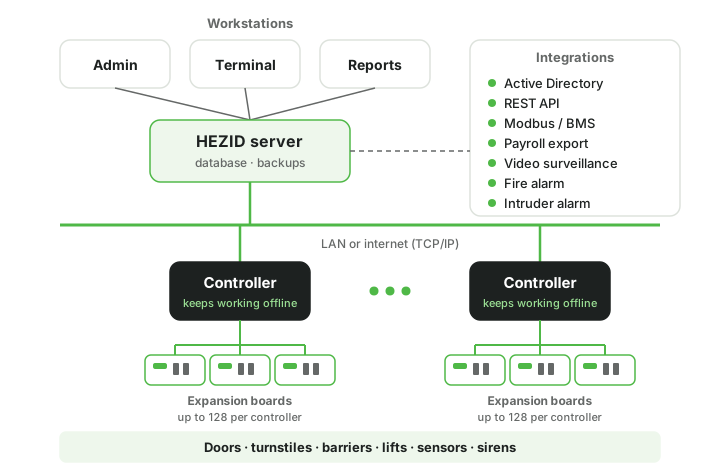
Own hardware and software, developed by Virtex. Decisions are made on site, in the controller, while the server collects data, distributes configuration and produces reports.
Four levels, each with its own role
Field devices
Readers, keypads, locks, turnstiles, barriers, sensors, buttons and sirens.
Expansion boards
Connect the devices of 1–2 doors. Up to 32 boards per communication line, at distances of up to 300–500 m.
Controllers
Make decisions, run the logic and store cards and events. They connect to the server over the local network or the internet.
Server and workstations
Central database, configuration, real-time monitoring and reports.
Pre-configured modules, assembled for your site
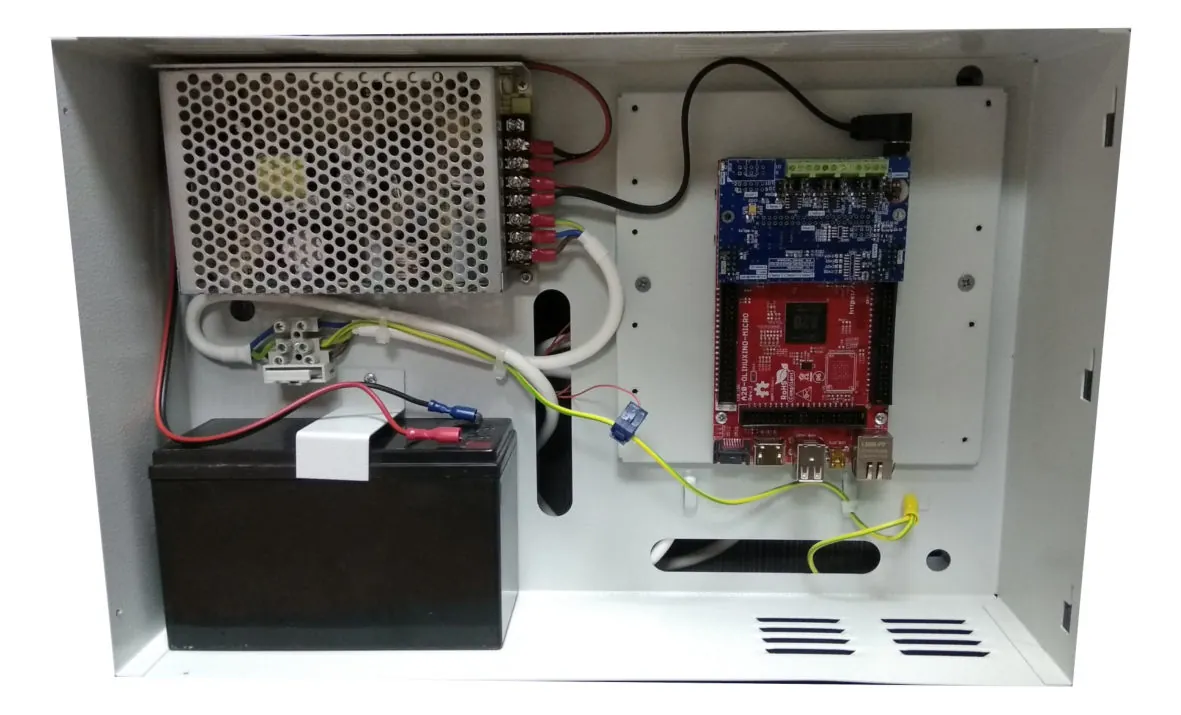
The system is built from pre-configured modules. The module code shows its contents: enclosure, controller, number of expansion boards and power supply. For example, module 1121 contains an enclosure, a controller, two boards and a power supply.
Controller
Industrial single-board computer running Linux (ARM, 1 GB RAM), with Ethernet and a real-time clock. Works standalone or as part of the system.
Expansion board
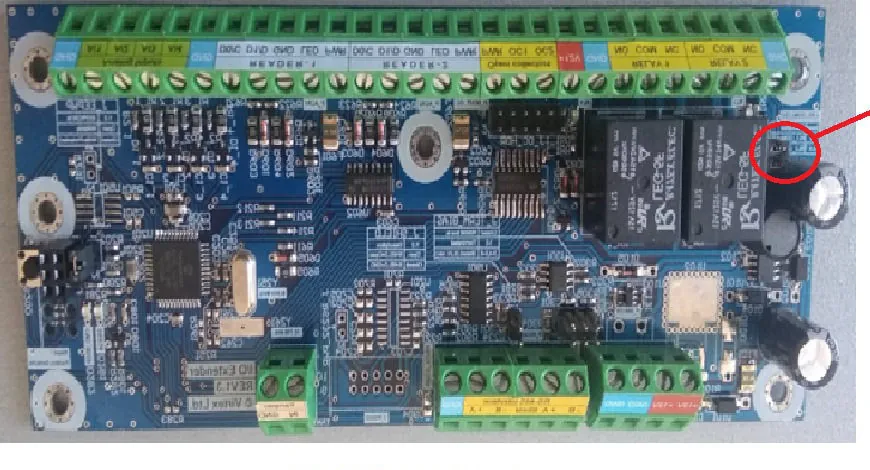
4 analogue and 4 digital inputs, tamper input, 2 relays, 2 open-collector outputs, 2 readers (Wiegand 26/30/36/44 or Magstripe). Inputs and outputs are configured in software.
Backup power supply
100–240 V AC input, 13.8 V / 3.5 A output. Switches to the battery automatically on mains failure.
Metal enclosure
400 × 260 × 100 mm, powder-coated, with a tamper switch.
Readers and terminals
125 kHz and 13.56 MHz (Mifare) readers, UHF vehicle reader up to 12 m, PIN keypads, ID document reader and a mobile time-recording terminal. Biometric devices: fingerprint, face, palm vein, iris.
Four applications with clear roles
HEZID Server
Communicates with controllers, sends them the configuration, collects events and backs up the database. Data is stored in a central PostgreSQL database. Supplied as a ready virtual machine or on a HEZID hardware server.
HEZID Admin
Configuration of sites, people and cards, schedules, working time, devices and logic. Operator rights by group: separately for each menu and action, and limited to selected branches.
HEZID Terminal
Real-time events with the cardholder's photo, alarms with acknowledgement, the state of each controller and buttons for remote commands.
HEZID Reports
Reports on access, location, working time, meals and change history. Export to PDF, Excel, CSV, Word and XML.
Additional modules: video server for a snapshot or clip on an event, ID document reader, Modbus server for building management, Web API, virtual reader for a phone or PC, and web reports for employees. There is no limit on the number of Admin, Terminal and Reports workstations.
Technical data
| Parameter | Value |
|---|---|
| Cards in one controller's memory | 1,048,576 |
| Events in one controller's memory | 16,777,216 |
| Expansion boards per controller | up to 128 (up to 32 per line) |
| Readers per controller | up to 256 |
| Access levels | up to 4096; up to 5 per card, each with validity dates |
| Time zones (weekly schedules) | up to 256, each with up to 16 intervals and holidays |
| Controllers in one system | unlimited |
| Workstations (Admin, Terminal, Reports) | unlimited |
| Anti-passback | local and global |
| Identification | card, PIN, biometrics and their combinations; two or three cards at one point |
| Reader protocols | Wiegand 26/30/36/44, Magstripe; keypads Wiegand 6/8 |
| Controller–server link | TCP/IP (LAN or internet), below 2 kB/s per controller |
| Operating temperature (controller, board) | −10 to +60 °C |
| Interface languages | Bulgarian, English, Russian |
The controller runs your rules
Besides checking permissions, each controller runs actions defined in HEZID Admin. They are triggered by decision tables with conditions and a default rule. See the automation examples.
Triggers
- card or PIN read
- input change (sensor, button)
- start and end of a schedule
- multi-step scenario
- event or controller start-up
- timer
Actions
- pulse, blink or switch an output
- lock or release a reader
- alarm and user event
- email to a responsible person
- write a Modbus register
- counter and credit on the card
Examples
- door free during working hours
- siren when a door is left open
- barrier after a second check
- limited number of entries
- lighting at the first entry
Enter data once, use it everywhere
Active Directory / LDAP
Periodic synchronisation of employees, departments and cards. Operator sign-in with a domain account.
Import
Cardholders, cards, photos and schedules from a file prepared in Excel. Import from SAP.
REST API
JSON interface for external systems: cardholders, cards and validity, access levels, access checks and filtered events.
Modbus / building management
The state of controllers, boards, inputs and readers is exposed as Modbus registers to the BMS.
Payroll systems
Export of hours worked to payroll software. An export to the Hermes payroll system is in use; other systems need an adaptation.
Video and third-party devices
Video server for IP cameras and DVR/NVR (Dahua SDK, RTSP): records a snapshot or clip on a controller event template. Plate-recognition cameras, barcode scanners, testers and other devices connect via Wiegand or dry contact.
Intruder alarm and fire alarm
HEZID performs intruder alarm functions: motion sensors and door contacts, arming and disarming with a card, sirens and notifications. On a signal from the fire alarm panel it unlocks the designated evacuation doors.
Biometrics
Fingerprint, face, palm vein and iris readers work on their own or combined with a card and PIN.
Designed to keep running
- The controller decides on its own and stores data locally when the network is down.
- Battery-backed power supply with automatic switchover.
- Configuration is kept in two copies with integrity checks.
- A watchdog restarts the application if it hangs.
- The state of every controller (power, battery, temperature, connection) is visible in real time.
- Automatic daily database backups, including to a second machine.
Server and network
- CPU64-bit x86, 2 cores (4 recommended)
- Memory8 GB (16 GB recommended)
- Disk250 GB (500 GB recommended)
- Environmentvirtual machine (VMware, VirtualBox, etc.) or HEZID hardware server
- Networkstatic IP address for the server
- WorkstationsWindows
Exact requirements depend on the number of controllers and the data volume. We confirm them during project design.
Need a technical consultation?
Send us your site layout and number of doors. We will propose modules, cabling and server configuration.