
Solutions

Access control, time and attendance and automation solutions

Organised by task, not by feature. Every scenario below is built from available HEZID components. For each one we describe how it works, the benefit, what is needed and where the limits are.

01

Access control for buildings and rooms

Everyone enters only where they need to and only when they should. Rights are granted and revoked centrally, with no keys or locks to change.

Discuss this scenario

How it works
The site is described as branches (buildings), zones (rooms) and control points (doors, turnstiles, barriers). An access level links points to a schedule. Up to 256 time zones (weekly schedules) each have up to 16 intervals and take public holidays from the calendar into account. A card can hold up to 5 access levels, each with a valid-from and valid-to date.
Benefit
When someone leaves, their card is blocked in one step. A lost card is stopped immediately. Every passage and every change of rights stays in the history.
What is needed
A module with controller and expansion boards, readers and locks or turnstiles, a server (virtual machine or HEZID hardware server) and a workstation with HEZID Admin.
Good to know
Sites in different time zones each get their own UTC offset. Administrators can be limited to their own branch.
02

Working time and payroll reports

Reader records become a ready report: who arrived when, how long they worked, who was late and who did not register.

Discuss this scenario

How it works
You define shifts with fixed or flexible hours, breaks and minimum and maximum duration. The employment contract sets the norm and the allowed shifts. The monthly roster is filled in manually, imported from a file or left on automatic mode, in which the system picks the shift from the employment contract based on the employee’s registrations. Absences are entered with a coefficient.
Benefit
The system calculates hours worked, lateness, balance against the norm and night work. Reports include missing registrations, insufficient daily and weekly rest, reports by department and branch, and the Bulgarian statutory forms 19 and 76. Every report exports to PDF, Excel, CSV, Word or XML.
What is needed
Time-recording points: the entrance readers or dedicated “start” and “end” readers, and HEZID Reports for the person in charge. A mobile terminal is available for temporary sites.
Good to know
Overtime and holiday work are not calculated as separate values; they appear in the balance. A closed period can be locked against changes.
03

Automation driven by events and schedules

The controller is also a small programmable automation unit. It responds to readers, inputs, schedules and timers without waiting for a person or the server.

Discuss this scenario

How it works
Actions and decision tables are defined in HEZID Admin. For example: “if the door stays open for more than 30 seconds, switch on the siren and send an email”, “the reception door is free during working hours and locked outside them”, “switch on the lighting at the first entry in the morning”. Tables can be triggered by an input, reader, keypad, access point, time zone, multi-step scenario, event code or controller start-up.
Benefit
Fewer manual tasks, timely response to incidents and energy savings. A new scenario needs new logic, not new hardware.
What is needed
Free inputs and outputs on the expansion boards (each has 2 relays and 2 open-collector outputs), sensors and a mail server for notifications. Modbus connects to building management.
Good to know
The board relays are for low DC voltage; lighting and machines need a contactor. Logic is set up by a trained administrator or by us.
04

Higher security for critical rooms

Server rooms, vaults, laboratories and valuable stores need more than one card. HEZID supports several levels of verification.

Discuss this scenario

How it works
Anti-passback, local and global: a card used to enter cannot let a second person in until the first has left, including across doors on different controllers. Biometrics: fingerprint, palm vein, face or iris, on their own or with a card and PIN. Card + PIN or two or three cards at one point, including the two-person rule. Multi-step scenarios: a sequence of checks on different readers with a time limit for each step, followed by an action such as opening a barrier.
Benefit
Card sharing stops and access to critical zones is documented step by step. The system also shows which zone each person is in.
What is needed
Readers at the zone entry and exit, PIN keypads or biometric readers and scenario configuration.
Good to know
Anti-passback works when the zone is closed, meaning both entry and exit go through a reader.
05

Car parks and vehicles

Employees and subscribers drive in without stopping for a card, and visitors get temporary rights.

Discuss this scenario

How it works
A vehicle is a cardholder with a licence plate. A plate-recognition camera passes the plate to HEZID as an identifier, and an expansion board output drives the barrier. A UHF reader with a range of up to 12 m is an alternative. Visitors get temporary cards that are activated and blocked as needed.
Benefit
No paper tickets and no cards for regular users. Car park rights are managed with the same access levels as the building, and every entry and exit appears in reports.
What is needed
A plate-recognition camera with Wiegand output or a UHF reader, a barrier and a controller with a board. Optional: free-stay periods, subscribers and a link to payment software.
Good to know
Recognition accuracy depends on the camera and site conditions. Paid parking with a ticket dispenser is designed for each site.
06

Lifts with access by floor

In multi-tenant office buildings and hotels, everyone goes only to their own floors.

Discuss this scenario

How it works
A reader in the car identifies the card. HEZID relays wired in parallel to the call buttons enable only the floors in the cardholder's access level. After the initial setup, rights are managed through access levels only.
Benefit
Tenants and guests cannot reach other floors, without a separate lift system.
What is needed
A reader in the car, expansion boards with relays for the buttons, access to the button lines of the lift controller (agreed with the lift maintenance company) and a current controller version.
07

Alcohol check at the start of a shift

For mining, energy, transport and manufacturing: nobody starts a shift without a negative test, and every attempt is recorded.

Discuss this scenario

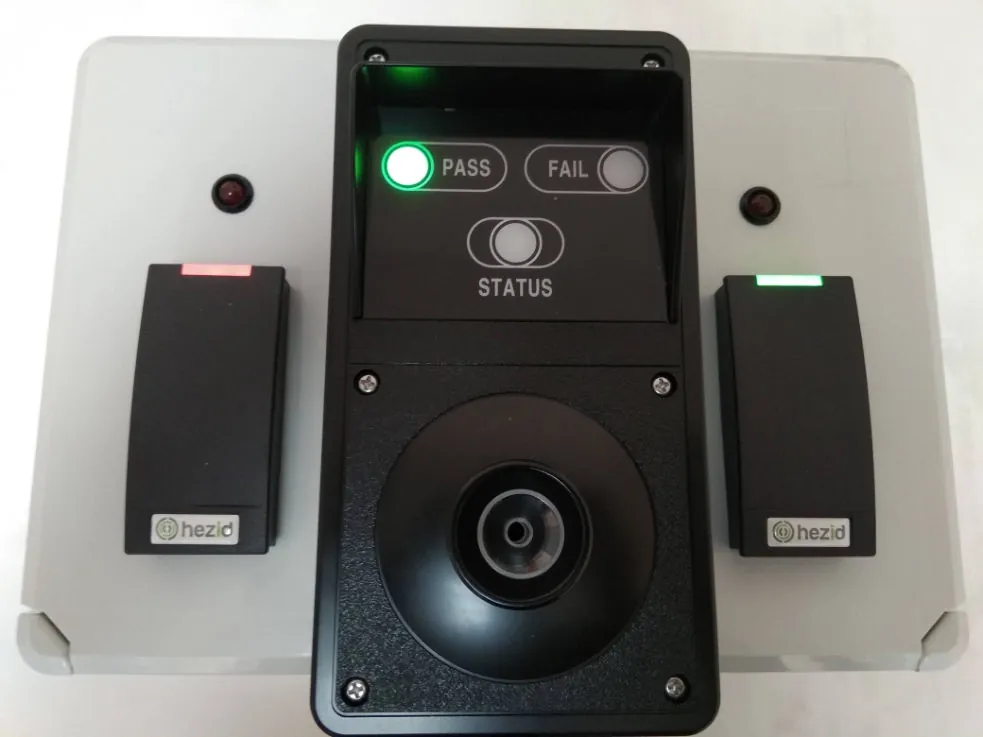
Panel with an alcohol tester and two HEZID readers for start and end of working time; the PASS and STATUS indicators are lit.
How it works
The employee presents a card and the tester is activated. On a negative test the start of working time is recorded and the turnstile opens. On a positive test access is denied, an event is logged and the responsible person receives an email. The steps must be completed within a set time (for example 20 seconds).
Benefit
The check is part of entering, not a separate procedure. The result and time are linked to the employee in the event history.
What is needed
An alcohol tester with control inputs and outputs, start and end readers, a turnstile, a controller with a board and a mail server. Optional: a video server for a snapshot on the event.
Good to know
The solution is delivered as a project. Internal rules and personal data processing must be assessed before introduction.
08

Visitors and registration from ID documents

Reception registers a visitor in seconds and issues a card only for the doors and time needed.

Discuss this scenario

How it works
An ID document reader fills in the name, document number and validity in HEZID Admin. The visitor receives a card with a limited access level and validity. On departure the card is released for the next visitor.
Benefit
Faster reception, no typing errors and a complete history of who was in the building and when.
What is needed
An ID document reader, a reception PC with HEZID Admin and a set of visitor cards.
Good to know
Collecting data from documents must follow your organisation's data protection rules.
09

Resources, limits and capacity

One card records and limits the use of shared resources: canteen, vending machines, rooms, subscriptions.

Discuss this scenario

How it works
Meals: a registration point in the canteen with a price and period reports. Limits: a counter or credit on the card limits the number of uses, such as entries per day. Capacity: the system counts the people inside and locks the entrance when the maximum is reached. Vending: the card enables a machine through a dry contact, with a minimum interval between two uses.
Benefit
Accurate data for charging and control of consumption without a separate system.
What is needed
A reader at the resource, an expansion board and logic configuration. For vending, an interface to the machine's controls.
Good to know
Counting people requires a reader at the exit as well.
More applications

Tasks customers solve with HEZID

The scenarios above can be combined. Here are more tasks from practice, built with the same components.

  • ManufacturingWho works on the machine, for how long and with what downtime? The reader identifies the operator and a “running / idle” sensor on a board input records the time. The report supports work norms and piece-rate pay.
  • ManufacturingOnly trained operators may use the machine. The reader at the machine enables power only for a card with the required access level. Boards are built into the machines, and one controller handles up to 128 of them.
  • Manufacturing, logisticsWho is still in the building during an evacuation? Readers between zones record where everyone is. The “who is in which zone” report is ready immediately.
  • Retail chains, banksMany sites, different old systems and manual spreadsheets. Controllers on every site and one central database. A new site is connected in one working day, and reports and payroll export cover them all.
  • Any siteOur old access control system is no longer supported. HEZID works with Wiegand and Magstripe readers, so existing readers and cabling can often stay. People and cards are imported from a file. Compatibility is checked during the site survey.
  • ConstructionWhich subcontractors are on site, and are they fit to work? An entrance portal with turnstiles, readers and an alcohol tester. Reports by company, person and hours. A positive test means no entry and an email to the supervisor.
  • SchoolsParents want to know when their child arrived at school. Readers or a turnstile at the entrance, attendance by class and a web report for parents.
  • Warehouses, plants, officesOut-of-hours security is a separate system. HEZID performs intruder alarm functions: motion sensors and door contacts, arming by the last person out with a card, sirens and email on a breach.
  • Public buildings, schoolsIn a fire or emergency the doors must react at once. A signal from the fire alarm panel unlocks the doors on the evacuation route. A panic button locks selected doors. Every action stays in the history.
  • Server rooms, labs, vaultsA card can be handed to someone else. Card, PIN and biometrics (fingerprint, palm vein, face or iris), or the two-person rule.
  • Shift workEmployees clock in for each other. At the start and end of the shift the card is confirmed with biometrics, for example a palm scan.
  • Office buildingsVisitors wait at reception for a pass. An external portal creates a temporary QR code with a validity period through the HEZID REST API, and the entrance reader accepts it.
  • Small and temporary sitesThere is no reader at the entrance. Employees clock in with a phone (NFC card or PIN) or with a USB reader on a PC.
  • Banks, retailAfter an incident at a door there is no evidence. On denied access or a forced door the video server records a snapshot or clip and links it to the event.

Your task is not on the list?

The controller is programmable and we develop custom features for specific processes. Tell us what needs to happen on your site.