
Access control and time & attendance system Who enters, how long they work and how your site responds — in one system
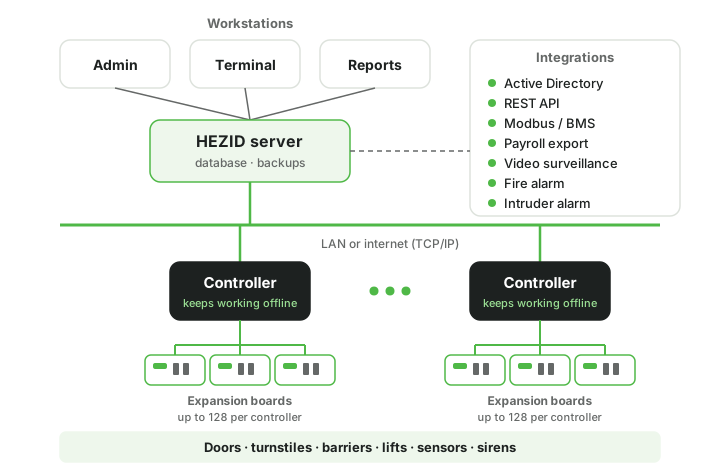
HEZID controls doors, turnstiles and barriers, records working time and runs the actions you define on events and schedules. Controllers make decisions on their own and keep working even when the connection to the server is lost.
What do you need to solve?
Choose the closest need to see how the solution works and what it takes.
- I want to know and control who enters, where and when
- I want accurate working-time records without spreadsheets
- I want the site to react on its own: alarms, notifications, lighting, machines
- Some rooms need more than one card
- I need control of car parks and lifts
- I want an alcohol check at the start of each shift
Six reasons you can verify on site
Works without the network
Each controller checks permissions itself and stores up to about 1 million cards and 16 million events. If the server connection drops, doors keep working and no records are lost.
Logic you define
With actions and decision tables the controller responds to readers, inputs, schedules and timers: it opens, locks, switches on a siren or lighting, or sends an email.
Access and working time together
One card swipe serves both the door and the timesheet. Shifts, flexible hours and night work are calculated from the same data.
Many doors, many sites
Up to 128 expansion boards and 256 readers per controller, and no limit on the number of controllers. Sites in different cities are managed from one database, with separate rights for each administrator.
Fits your environment
Active Directory synchronisation, employee import from Excel or SAP, a REST API, Modbus to building management and export to payroll systems.
Developed and supported in Bulgaria
Both hardware and software are made by Virtex. Support, training and custom development come from the team that builds the system.
From card to report
Identification
An employee, visitor or vehicle is identified by card, PIN, licence plate or a combination of these.
Decision on site
The controller checks the access level, schedule, card validity and anti-passback rule and decides immediately, without waiting for the server.
Action
The defined actions run: opening a door or barrier, a signal, an alarm, an email or a command to another system.
Record
The event reaches the server. Operators see it in real time, and access and time reports are ready to print or export.
Scale without extra servers
1,048,576
cards in controller memory
16.7 M
events stored locally
128
expansion boards
4096
access levels
The system grows with any number of controllers on the same server. Full technical data
Do you recognise your task?
HEZID has been deployed in schools and universities, hospitals, retail chains, banks and office buildings, manufacturing plants, warehouses and utilities. Here are tasks it solves.
“We don’t know how much each machine really works.”
A reader and a sensor on the machine show who operated it, for how long and with what downtime.
Retail chains“Every site has its own system and its own spreadsheets.”
One central database for all sites. Working time for everyone goes to payroll from one place.
Construction“We don’t know which subcontractors are on site.”
An entrance portal with a turnstile, readers and an alcohol test. Reports by company, person and hours.
Schools“When did the pupil arrive and when did they leave?”
Readers or a turnstile at the entrance, attendance by class and a report for parents.
Warehouses and plants“At night there is nobody on site.”
HEZID also works as an intruder alarm system: the last person out arms it with a card.
Critical rooms“A card can be handed to a colleague.”
Card, PIN and biometrics, or the two-person rule.
Public buildings“In a fire or an emergency the doors must react on their own.”
A fire alarm signal or a panic button unlocks or locks groups of doors.
Any site“Our old system is no longer supported.”
Keep your readers and cards and replace the controllers. People and cards are imported from a file.
See the system in action
Describe your site and task. We will show HEZID with sample data and propose a configuration.